
Both are organizations/brand names that provide the materials for diver training.
There are more organizations, such as RAID, or CMAS in various forms (each country is different here), but PADI and SSI are probably the best known worldwide.
No matter which organization you choose in the end, the instructor is much more important than the organization.
Differences in training
I will only go into PADI and SSI here, as I am authorized to teach for these two.
I could only provide dangerous half-knowledge about others, which I avoid.
In SSI there are some exercises that are characterized by technical diving. However, the basic exercises are almost the same.
Similarities and ISO standard
If you want to get your diving license, the difference is not really that big.
Both organizations follow the ISO standard, which means that a diving certificate from one organization is recognized anywhere in the world and by any other organization.
Both trainings teach you (should teach you) how to be a responsible and safe diver. The Open Water Diver certification means you are safe enough to go underwater alone with another certified diver (dive buddy) if the worst comes to the worst.
Think of the diving course like your driver’s license. Here too, you had to learn how to deal with dangerous situations – which hopefully will never happen if you do everything else right. Every learner driver has to learn the same rules, the same safety exercises. But how they are taught may differ slightly.
In contrast to the driver’s license, however, the diving licence from these two organizations is recognized worldwide. And it is valid for life (which could be questioned….).
Special differences
Here are a few examples of the differences:
- PADI teaches an ascent rate of 18m/min
- SSI 9m/min (most instructors will tell you that this is the safer option)
- with PADI you are an “Advanced Open Water Diver” after your 2nd course
- with SSI you do the same course, but here it is called “Advanced Adventurer”. Only after 24 logged dives and 4 specialties is it renamed “Advanced Open Water Diver”.
- In the PADI “Advanced Open Water Diver” course, the deep and navigation dives are mandatory
- The SSI “Advanced Adventurer” course does not require a dive, but every decent dive store will carry out deep and navigation dives, otherwise you will not have the same level as the PADI certificate.
These are just a few examples to illustrate that there is no significant difference.
App logbook
With both organizations you can log your dives in the respective app.
Only SSI uses QR codes for this. In SSI, dives are “verified”, i.e. even after the diving license, if you do so-called fun dives, these can be verified with the QR code of the store.
Many divers who come from SSI and dive with a PADI store ask for this QR code.
A PADI store cannot have this, as each store has to choose one organization and cannot offer both.
However, this does not mean that your dives are not official. Since you are officially allowed to dive alone with a buddy with your certificate, any other certified diver can verify your dive. There doesn’t have to be a green checkmark in the app. As long as you enter the dives, everything is okay.
Why is it important to log dives?
Firstly, as professionals, we can assess what you need in our store based on your previous dives and the equipment you used.
For this, you should at least enter which BCD size you used, which tank size and material, which wetsuit and which equipment you need.
It is also your proof of the total amount of dives you have done, which different dives (deep, navigation, current…) to proof your experience level.
In case you have really forgotten your certification card, no picture, there is no internet connection – so no proof at all you can show – this logbook can also be considered as proof that you are a certified diver and your experience level.
Training material
As it is the right time, I will only go into the online material here. Some dive stores still use books – for what reason is not clear to me.
As sorry as I am for PADI, I personally find SSI’s online training material better. For students.
However, I find the part for diving instructors with all the standards etc. better at PADI.
PADI app and PADI eLearning (non professionals)
PADI offers 3 different apps:
- PADI App – for certification cards, logbook, course material (only with internet connection), etc
- PADI eLearning – only course material, but here with the possibility to download the courses
- PADI Adventure – for travel bookings
Why exactly the developers have decided to make such a separation in this day and age is beyond me.
There are also a lot of homepage links hidden in the app under apparent app functions. Here you are directed back to the PADI homepage and, in the worst case, have to log in there again. This technology is ok for a beta version, but no longer up to date.
Especially not if you are creating material for diving students who often do their training in remote countries without constant access to an internet connection.
The PADI eLearning app previously offered the choice of whether to download the content or not. Now, each selected chapter is downloaded and the indication of a WiFi connection is displayed. If you work through an entire course, this is also a bit annoying after a while. Especially if you are logged into a WiFi connection.
SSI App (non professionals)
For my ITler taste, the SSI app is much better structured, more intuitive to use and combines everything in a single app. The overall layout is also more contemporary.
In addition, SSI works with QR codes in many areas of the logbook function, which makes it much easier to enter a dive buddy, certify training dives by the instructor and verify a fun dive using the store QR code.
Comparison of content (non-professionals)
I would not presume to be able to judge the respective content, as I would not be able to put something like this together.
In addition, everyone learns differently and understands teaching material in a different way.
In my own personal experience with the courses, however, I felt more comfortable with SSI.
With PADI you can fail and the dive store has to check this, with SSI you repeat until you achieve 100%.
Does it make a difference if I want to become a diving professional?
Simply put: YES.
In this case, you should find out in advance which organization more stores belong to, depending on where you want to go in the world.
Here is a small overview in which I have counted the number of stores displayed on the relevant organization pages. I take no responsibility for the accuracy of this information.
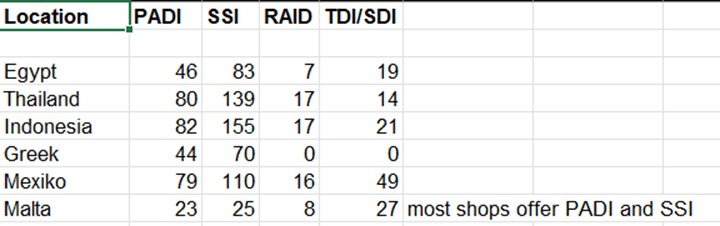
But you can already see from this that SSI now predominates.
However, PADI is still the top dog in terms of popularity.
Many divers come to our store and don’t ask for the “Open Water” course. They say “I want to do my PADI.”
I haven’t collected any figures here, but in Europe, especially in Germany and France, CMAS probably still predominates.
Significant differences for Divemaster
The PADI Divermaster course is a course that also includes all diving theory.
SSI has divided this course into 3 parts. The “Dive Guide”, “Science of diving” and “Divemaster”.
A certified and active PADI Divemaster may conduct refresher courses independently.
A certified and active SSI Divemaster may not. In SSI, only an assistant instructor may conduct a refresher course.
Read more in I am thinking about doing my Divemaster training (DMT)
Significant differences for Instructor
PADI Instructors can work independently, i.e. I can simply rent equipment, buy the materials and teach everyone without belonging to a store.
PADI instructors are therefore also solely responsible!
If a store books a freelance instructor and this instructor carries out a service requested by the store that endangers the safety of the students and violates the PADI standards, the instructor will be questioned. The store will only receive an informative email. The instructor is also the one who is accountable to PADI.
In the worst case, this can lead to the loss of active status, which means that the instructor is no longer allowed to teach.
SSI has a different approach here. An SSI instructor can only teach in conjunction with a store. This means that I could not simply teach my friends independently with SSI.
However, this also means that in the event of a breach of standards or danger to students, the entire store is checked by SSI. Not just the instructor conducting the course.
According to the standards, a PADI instructor is not allowed to carry anything that takes their attention away from the students on any course. This includes cameras and action cams.
According to SSI standards, the instructor may carry and use an action cam for group photos in the Try Scuba course.
However, this is the only course where this is permitted. In all other cases, the same rules apply as in PADI.
Now it is debatable whether SSI is undermining its own standards here.
Many stores now offer photos included in the price.
According to the standards, this is only legal in 2 cases: Either SSI Try Scuba and then only one actioncam. Or an additional dive is offered in the course. Open Water courses, for example, officially include 4 official Open Water training dives in both organizations.
If the store offers 5 dives and the students are already certified on the last dive, they are considered Fun Divers and the instructor may take a camera with them.
If you are offered something else, please bear in mind that your instructor is breaking, or has to break, standards.
The importance of the diving instructor
Let’s take the driving license as an example again. I had 3 different driving instructors during my motorcycle training and only the last one was really good. Of course I would have passed my motorcycle license with one of the first two, but would I have become as good a driver as I was with my final instructor? No.
The driving instructor made a huge difference here and I rejected the 2nd one after just one day.
Security and intuition
Diving is still a dangerous sport, don’t forget that!
As much fun as the course and diving is, you want to be safe after completing the course and not risk your life.
My tip to all my diving students: listen to your intuition.
The right diving instructor for you
Not every instructor is the right person to teach YOU.
We all have different approaches to our teaching style.
I personally teach with a lot of fun, but that stops when it comes to the safety of my divers. I take a lot of time, explain a lot and would never force someone to do something they don’t feel comfortable with.
However, this is not the right teaching style for all students. I’ve also had some who needed a stricter approach. But that’s not me.
But we are also paid on a commission basis. This means that, depending on where we work, we only get paid when the student completes the course (which, in my personal opinion, does not speak in favor of the dive store).
My very personal approach here is: I’d rather give up money than ruin the experience of diving for someone. Even if that means putting my ego on the back burner and finding someone better for that student.
Unfortunately, this is not always the case. What’s more, we’re only human and we can have bad days too.
But I can give you one thing along the way: Whether it’s a driving or diving instructor, someone who doesn’t have the patience to teach you something is not a good teacher! You shouldn’t feel unsafe or be pushed into something that is too much for you.
If you don’t feel comfortable, talk to the management.
What’s the worst case scenario that can happen? You lose money. How does that compare to a good experience and the knowledge that you’ll be safe in the end?
But usually a solution can be found.
This is not “snitching” or anything like that. You pay and you should feel comfortable. If this is not the case, it is a good reason to talk about it.
Conclusion
I did the main part of my diving training with PADI, but also did some courses with SSI on the side.
As long as you don’t get into the professional area, it doesn’t matter. You can jump back and forth between the two organizations.
From the professional level, especially as a diving instructor, it gets interesting and here you should do your research in advance.
 Dive into you - Let´s dive into a different perspective of yourself
Comments
2 responses to “What exactly is the difference between PADI and SSI?”
[…] Read more in What exactly is the difference between PADI and SSI? […]
LikeLike
[…] Read more in What exactly is the difference between PADI and SSI? […]
LikeLike